Factory Direct Catalog
Engineered Glass Door & Window Systems
Custom-fabricated from 6063-T6 architectural extrusions, certified insulated glass packages, and precision-welded frame structures built to project submittals.
Manufacturing Capabilities
Why Leading Global Specifiers Choose Chinese Fabrication
Uncompromising structural integrity, advanced metallurgical extrusions, and rigorous quality assurance tailored for high-end architectural deployments.
Solid 6063-T6 Extrusions
Unlike standard residential grade aluminum, our factories utilize premium 6063-T6 temper extrusions. This high-density alloy delivers superior tensile strength, ensuring structural deflection stays within tight tolerances even under high wind pressure loads in coastal high-rises.
Sigma-Welded Joint Integrity
Corner joints are sigma-welded, dressed smooth, and sealed rather than relying solely on mechanical screws and crimps. A welded seam behaves as one continuous structural metal body, preventing water ingress pathways and racking over decades of heavy usage.
Coastal Corrosion Protection
Our surface finishing options include fluoropolymer PVDF (Kynar 500) coatings and high-micron anodizing specifically designed to survive salt spray environments. Paired with 316-grade stainless hardware, frame oxidation and degradation are effectively eliminated.
Global Glass Door Procurement & Manufacturing Trends (2025–2030)
The global architectural sector is undergoing a massive transformation driven by stringent decarbonization targets, stricter municipal energy codes (such as Energy Star v7.0 and European Passive House standards), and an architectural push toward hyper-minimalist aesthetics. Sourcing glass doors directly from premier Chinese OEM/ODM facilities allows developers, contractors, and importers to leverage cutting-edge manufacturing technology at competitive scale economies.
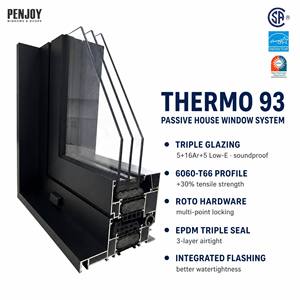
Information Gain Insight: Modern architectural glass doors are no longer treated as simple passive barriers. They are engineered composite structural assemblies featuring polyamide thermal breaks, multi-layer Low-E coatings, argon gas fill ratios over 90%, and integrated smart automation.
1. Transition to Structural Slim-Profile Systems
Architects are pushing sightlines to absolute minimums while demanding larger glass panel formats. Leading Chinese exporters achieve this through structural glazing adhesives (such as Dow Corning silicone structural sealants) combined with hidden frame extrusions. Interlock sightlines on multi-panel sliding doors have dropped from 50mm down to 18mm, allowing over 95% daylight clearance without sacrificing wind-load resistance (up to 5.0 kPa rating).
2. Advanced Thermal Isolation & Polyamide Technology
Non-thermal aluminum framing is now restricted to non-conditioned interior spaces or mild climate zones. For exterior fenestration, factories integrate multi-cavity glass-fiber reinforced Polyamide (PA66GF25) thermal strips. This mechanical barrier breaks thermal conductivity between exterior and interior aluminum extrusions, eliminating condensation ("frame sweating") and lowering overall fenestration U-factors down to 0.8–1.2 W/m²K.
3. Specialized High-Performance Glass Packages
The choice of insulated glass units (IGU) dictates up to 80% of a door's total energy performance. Chinese exporters offer customized glass configurations tailored to precise macroclimates:
- Solar Control Low-E: Double or triple silver sputtered Low-E coatings selectively reflect infrared thermal radiation while maintaining visible light transmittance (VLT).
- Acoustic Laminated Glass: Utilizing multi-layer Polyvinyl Butyral (PVB) or acoustic grade interlayers, reducing ambient exterior noise by up to 45 dB (STC ratings > 42).
- Hurricane Impact Security: Incorporating structural SentryGlas® (SGP) interlayers designed to withstand missile impact criteria under ASTM E1996 and Florida Building Code standards.
4. Integrated Screening Solutions
Modern door systems require seamless insect protection that does not ruin exterior elevations. Leading factories now pre-build roll-formed aluminum screening modules—offering both flat frame and long-leg frame designs with high-durability 16x18 charcoal fiberglass mesh or stainless steel security mesh directly recessed into the track assembly.
Engineering Depth: Welded Assembly vs. Standard Mechanical Screwing
A critical metric of E-E-A-T (Experience, Expertise, Authoritativeness, and Trustworthiness) when auditing glass door manufacturers is evaluating corner joinery techniques. The table below illustrates why engineered sigma-welded joints outperform conventional knock-down (KD) screw-assembled frames across long-term building lifecycles.
| Engineering Feature |
Sigma-Welded Frame Joints |
Mechanical Screwed / Crimped Joints |
| Structural Rigidity |
Monolithic single-body structure. High torsion resistance. |
Relies on corner cleats & screws. Susceptible to racking under heavy door loads. |
| Water Infiltration Path |
Zero seam gaps. Complete seal continuity. |
Sealant degrades over time, creating micro-gaps for water leakage. |
| Maintenance Lifecycle |
Maintenance-free structural joint for 30+ years. |
Requires periodic retightening and re-caulking at corner junctions. |
| Aesthetic Finish |
Dressed smooth before powder coating for seamless corners. |
Visible joint lines and exposed hardware fastings. |
Why specify 6063-T6 aluminum extrusions over wood or vinyl for commercial glass doors?
Solid 6063-T6 aluminum frames offer exceptional structural stability, holding precise dimensional tolerances even when subjected to thermal expansion, high humidity, and heavy structural glass loads. Wood swells, rots, and warps under moisture exposure, requiring ongoing scraping, painting, and expensive structural maintenance. Vinyl (uPVC) lacks the structural modulus needed for expansive floor-to-ceiling glass wall designs and can yellow or sag under extreme heat. Aluminum delivers narrower sightlines, larger glass panel capacity, and virtually zero ongoing maintenance when paired with a factory PVDF finish.
What is a thermal break barrier, and when is it mandatory for project submittals?
A thermal break is a continuous insulating polymer strip—typically made of glass-fiber reinforced polyamide (PA66GF25)—placed inside the inner and outer aluminum extrusion profiles. Because metal is highly conductive, a non-thermal frame readily transfers outdoor hot or cold temperatures into conditioned interiors. The thermal break interrupts this conductive loop, dramatically lowering the total U-factor and preventing internal frame sweating. A thermal break is mandatory for conditioned living spaces in cold or humid zones, energy-code compliant commercial developments (NFRC/Energy Star), and wherever interior moisture could ruin adjacent drywall or hardwood finishes. Non-thermal frames remain an economical option for interior partition doors, unconditioned screen rooms, or mild climates.
How do Chinese factories ensure corner joint integrity on large sliding and swing doors?
Leading Chinese export manufacturers utilize high-precision CNC miter saws combined with continuous sigma welding or automated mechanical corner crimping with injected dual-component structural adhesives. Every corner joint is checked for squareness and dressed smooth prior to surface finishing. Welded and adhesive-injected joints behave as single structural elements, preventing frames from racking out of square during transport or loosening under heavy daily usage cycles.
Are custom sizes, non-standard elevations, and submittal drawings supported?
Yes. Factory-direct sourcing caters primarily to custom architectural submittals rather than restrictive off-the-shelf catalog sizes. Overseas buyers can supply CAD files, REVIT BIM models, or architectural shop drawings. Factory engineering teams generate detailed submittal packages showing net opening dimensions, frame depths, glass bites, hardware placement, and wind load calculations for final client sign-off before any extrusion is cut.
What surface coatings are recommended for high-salinity coastal coastal installations?
For marine or coastal project environments within 5 miles of salt water, standard powder coating is inadequate. We specify high-durability PVDF (Fluoropolymer Kynar 500) 3-coat finishes compliant with AAMA 2605 specifications, or deep anodic oxide coatings (>20 microns). Furthermore, all visible hardware components, rollers, track guides, and fasteners must be upgraded to SUS316 stainless steel to ensure complete resistance against salt spray pitting and galvanic corrosion.
How are insect screens integrated into multi-panel glass door systems?
Factory production offers two primary screen structural profiles: flat frame and long-leg frame designs. Built from roll-formed aluminum channel profiles, these screens hold durable 16 x 18 charcoal fiberglass mesh or stainless steel mesh retained by heavy-gauge vinyl splines. Multi-panel sliding doors utilize matching parallel screen tracks, while folding doors incorporate retractable pleated screen cassettes that tuck neatly into the jam frame when not in operation.
What international testing standards and quality certifications should buyers verify?
When importing glass doors from China, buyers should verify compliance documentation for NFRC (National Fenestration Rating Council) thermal performance, AAMA / WDMA / CSA 101/I.S.2/A440 structural standards, CE marking for European markets, and SGCC (Safety Glazing Certification Council) or EN 12150 compliance for tempered architectural glass safety.
Ready to Source Engineering-Grade Glass Doors?
Send us your project submittals, elevation schedules, or opening dimensions. Our engineering shop will return a detailed line-item quote and profile consultation within 24 hours.
Get a Quote