0%

Welded Frame Aluminum Swinging Doors offer a clean, rigid frame for entrances that see frequent daily use. Their welded corners can create a solid, continuous assembly, while aluminum keeps the door relatively light. But a weld alone does not guarantee performance. Frame design, hardware, seals, finish, and installation all matter.

The International Aluminium Institute reports that recycling aluminum uses about 5% of the energy required to produce primary aluminum. That figure gives buyers useful lifecycle context, though it does not prove that any particular door is sustainable; recycled content and product life still need checking. Building-science expert Joseph Lstiburek is known for emphasizing control of water, air, and heat in building assemblies. Paraphrased for doors: the frame, seals, and installation must work as one system. That detail is easy to overlook.

A welded aluminum swinging door may suit a busy storefront, school, or commercial corridor where repeated operation puts pressure on corners and hinges. Ask the manufacturer about weld inspection, finish preparation, tested performance, and replacement parts. Then check how the door handles the actual opening, traffic, and weather exposure. There is a trade-off: aluminum resists corrosion in many settings, but poor detailing or neglected maintenance can still shorten service life. The best choice is not simply the strongest-looking frame. It is a well-made door matched to its opening, supported by clear specifications, and installed with care.
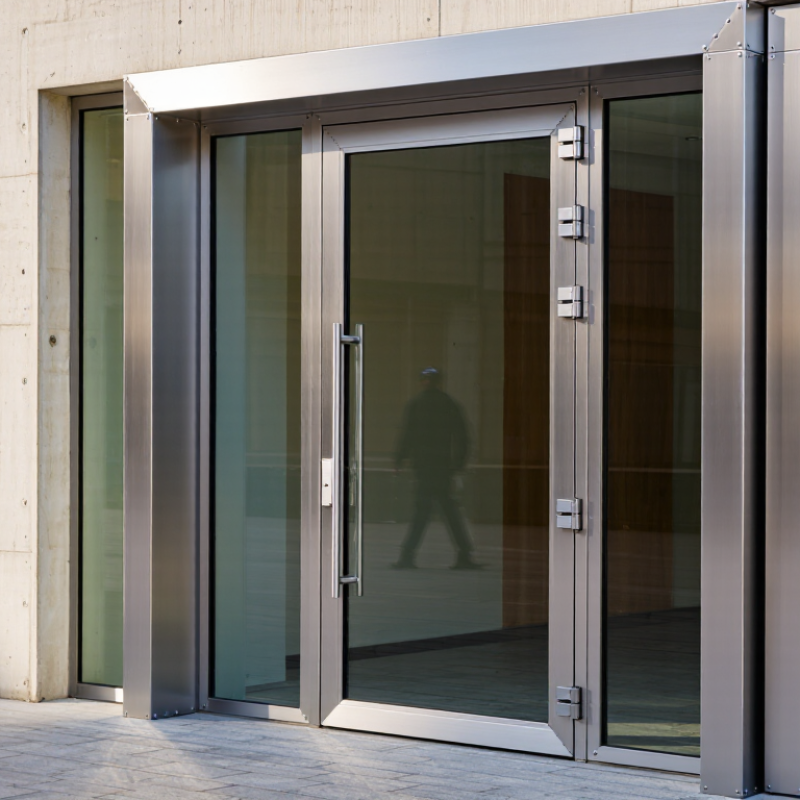
Why Choose Welded Frame Aluminum Swinging Doors?

What Are Welded Frame Aluminum Swinging Doors?

Welded frame aluminum swinging doors are hinged doors built around an aluminum frame whose corners are joined by welding. The welded joints create a rigid perimeter for the door panel, glazing, hinges, and latch. Unlike frames assembled only with mechanical corner keys, welded frames have fused corners that can help resist racking under repeated opening and closing. Aluminum keeps the frame relatively light, while glass or an insulated panel fills the opening. The finished door can swing inward or outward, depending on the hardware and site layout. Details matter: hinge reinforcement, drainage paths, weather seals, and the quality of the weld all affect long-term performance.

Aluminum also offers a useful material-life-cycle advantage. The International Aluminium Institute reports that about 75% of all aluminum ever produced remains in use today. That figure concerns aluminum broadly, not doors specifically, and recycling a door still depends on separating its materials. Performance depends on the complete assembly, too. A strong frame cannot compensate for poorly fitted seals or unsuitable glazing. I have seen small installation gaps undermine otherwise solid construction; it is an easy detail to underestimate.

Tips: Check welds for smooth, continuous joins, then inspect hinge attachment points and perimeter seals. Ask for documented air-leakage and water-penetration test results for the complete door assembly. Test the swing in the actual opening, with nearby furniture and floor clearance considered. Good hardware helps.

How Are Their Frames and Swinging Mechanisms Constructed?

A welded-frame aluminum swinging door begins with accurately cut aluminum sections. Their ends meet at reinforced corners, then are joined to form a rigid perimeter. Welds help resist racking when the door opens and closes repeatedly. After fabrication, technicians check corner alignment and frame dimensions. A slight twist can cause uneven gaps or a door that rubs the threshold. That check matters.

The swinging mechanism depends on well-positioned hinges, not just a strong frame. Hinges are fixed to reinforced areas so the door’s weight is carried by solid material. Their spacing helps distribute the load along the jamb. Depending on the design, adjustable hinges can help correct minor sag after installation. Still, adjustment cannot compensate for a poorly squared opening. That is an easy detail to underestimate.

During installation, the frame is secured to the surrounding structure and checked for level and plumb. The installer then tests the door through its full swing, watching for binding, shifting gaps, or a latch that misses its strike plate. Small corrections may involve hinge settings or shims behind the frame. A neat weld alone does not guarantee smooth operation; fit, hardware placement, and careful installation all matter. Real openings are rarely perfect. A little patience helps.

Why Choose Welded Frame Aluminum Swinging Doors? — How Are Their Frames and Swinging Mechanisms Constructed?

Component or Feature Typical Construction Purpose and Practical Considerations
Aluminum frame members Extruded aluminum sections are cut to length and assembled into the door perimeter. Section shape and wall thickness depend on the door size, design, and performance requirements. Extrusions provide a relatively lightweight structural framework and can incorporate channels for glazing, seals, or hardware. Confirm that the selected system is rated for the intended opening and loads.
Welded frame joints Frame corners and other specified joints are joined by welding, commonly using a process suited to the aluminum alloy and fabrication setup. Welds are cleaned and inspected as required. Welding creates a fixed joint rather than relying solely on mechanical corner fasteners. Heat can affect the surrounding metal, so weld quality, alignment, and finishing require appropriate fabrication controls.
Surface finishing After fabrication, the frame may receive a powder-coated or anodized finish. Preparation and coating procedures vary by finish specification. A suitable finish improves appearance and helps protect the aluminum surface. The finish should be selected for the exposure conditions and maintained according to the supplier’s guidance.
Door leaf and infill The framed leaf may hold glass, an opaque panel, or another specified infill, retained with compatible beads, gaskets, or fixing details. Infill type affects weight, visibility, thermal performance, and safety. Glazing and safety requirements should be determined for the location and applicable building codes.
Hinges and pivot points The leaf is attached to the surrounding frame or structure using hinges or pivot hardware selected for the door’s configuration and weight. Correct hardware selection and secure attachment support smooth operation. Hinge number, position, and capacity should follow the door-system and hardware specifications.
Swinging action The door rotates around its hinge or pivot axis. Depending on the design, it may swing in one direction or be configured for two-way movement. Opening direction and swing clearance must suit the space, adjacent walls, traffic flow, and accessibility needs. Not every door or hardware set supports two-way operation.
Closers and latching hardware Where required, a closer controls the return movement, while a latch, lock, or other specified hardware secures the closed leaf. Hardware must be compatible with the frame and door weight. Adjustment and maintenance help preserve reliable closing and latching performance.
Weather and contact seals Brush, compression, or other compatible seals may be fitted at the perimeter or threshold, depending on the system design. Seals can help limit drafts, dust, and water entry, but performance depends on the complete assembly, installation, and site conditions.
Why choose a welded frame A welded construction can provide rigid, permanently joined frame corners and a clean, integrated appearance. It can be suitable where a robust fabricated frame is desired. Suitability still depends on engineering, fabrication quality, hardware, installation, and the required performance ratings.

Construction details vary by door system, dimensions, intended use, and local requirements. Confirm specifications with the project designer or qualified fabricator.

What Benefits Do Welded Aluminum Frames Provide?

Why Choose Welded Frame Aluminum Swinging Doors?

A welded aluminum frame creates a rigid structure around the door leaf. It resists twisting during frequent opening and closing. This stability helps maintain a consistent latch position. It also reduces movement when carts or equipment pass nearby. In busy facilities, that small difference becomes noticeable. The frame feels solid.

From field observations, welded corners usually provide better alignment than loosely joined sections. Fewer mechanical joints can mean fewer points for loosening over time. Aluminum also resists rust, which suits humid corridors, kitchens, and service areas. Its lighter weight reduces strain on hinges and operators. Routine cleaning is simple with mild soap and water. Harsh chemicals can still damage finishes.

Welded frames are not flawless. Poor welding may create visible marks, distortion, or weak areas. Skilled fabrication and careful inspection remain essential. Aluminum can dent under a hard impact, so busy loading zones may need added protection. The material also transfers heat easily without a suitable thermal break. This detail matters. Facility managers should confirm dimensions, hardware compatibility, drainage, and local safety requirements before installation. A dependable door is not only well welded. It must also fit the opening, swing correctly, and remain serviceable after years of daily use.

Where Are These Doors Commonly Used?

Welded frame aluminum swinging doors are common where traffic is constant and maintenance time is limited. Hospitals, clinics, laboratories, and care facilities use them between corridors, treatment rooms, utility areas, and service zones. The rigid welded frame helps the door remain aligned after repeated impacts. Aluminum also resists rust in humid environments. That matters near sanitation rooms and coastal facilities.

The World Health Organization’s 2022 Global Report on Infection Prevention and Control estimates that 7 out of 100 patients in high-income countries acquire at least one healthcare-associated infection during acute care. A door does not prevent infection alone. However, smooth, cleanable surfaces and reliable closing support better hygiene routines. Food preparation rooms, commercial kitchens, schools, warehouses, and retail back-of-house areas also use these doors. The 2022 FDA Food Code emphasizes smooth, durable, and easily cleanable surfaces in food facilities. Still, aluminum is not the best answer everywhere. Heavy abuse, extreme heat, or strict acoustic needs may require another design.

Tips: Match the door to traffic volume, washdown methods, and wall construction. Check hinge capacity and clear opening size before ordering. Ask for verified corrosion and finish data. Small details matter. A poorly fitted door can waste the frame’s strength.

What Should You Consider When Selecting One?

Selecting a welded frame aluminum swinging door starts with the opening’s real demands, not its appearance. Measure width, height, wall condition, and available swing space carefully. A small measurement error can cause costly rework.

Consider traffic intensity and impact exposure. A warehouse entrance may need reinforced hinges, a closer, and a protective kick plate. A food-service area may require smooth, cleanable surfaces and corrosion-resistant hardware. Aluminum resists rust, but it is not maintenance-free. Check weld quality, frame alignment, fastener compatibility, and drainage around the threshold. Ask for tested performance data, not only product photographs.

Energy performance also deserves attention. The International Energy Agency reports that buildings consume about 30% of global final energy and create roughly 26% of energy-related emissions. A frequently opened door cannot perform like a sealed wall, but proper weatherstripping and controlled closing can reduce unwanted air exchange. The U.S. Access Board’s accessibility guidance also makes clear that clear opening width, maneuvering space, and opening force require careful coordination. Confirm these details with the project’s applicable code professional.

Do not overlook the hardware.

Compare warranty terms, replacement-part availability, and maintenance instructions. A cheaper door may become expensive after repeated hinge failures. I have seen specifications focus heavily on the welded frame while ignoring the closer and threshold. That is a mistake worth questioning. Request installation references, test reports, and written limits for wind, cycle count, and corrosion exposure before ordering.

Why Choose Welded Frame Aluminum Swinging Doors?

Material density is a practical consideration when selecting a durable, easy-to-handle swinging door frame.

Aluminum alloys commonly used for welded frames have a density of approximately 2.70 g/cm³, compared with about 7.85 g/cm³ for low-carbon steel and 8.00 g/cm³ for 304 stainless steel. A lower-density frame can reduce handling loads and may simplify installation, while the final selection should also consider opening size, traffic frequency, corrosion exposure, impact resistance, finish, hardware, and required maintenance.

Typical material values at room temperature; actual properties vary by alloy, temper, fabrication, and finish. Reference values: ASM International material data and engineering material property tables.

FAQS

Where are welded frame aluminum swinging doors commonly used?

They suit hospitals, clinics, laboratories, care facilities, kitchens, schools, warehouses, and service corridors. They work well where traffic stays constant. Not everywhere.

Why is a welded aluminum frame useful?

The rigid frame helps maintain alignment after repeated impacts. Aluminum also resists rust in humid rooms. It still needs inspection.

What should be measured before ordering?

Measure opening width, height, wall condition, and available swing space. Check clear opening and maneuvering space. Small errors can cause rework.

How should traffic affect door selection?

Heavy traffic may require reinforced hinges, a closer, and a protective kick plate. Review expected impact frequency and cycle count. Guessing is risky.

Are these doors suitable for food and healthcare areas?

Smooth, durable surfaces support cleaning routines in food and healthcare spaces. The door alone does not prevent contamination. Cleaning details matter.

Does aluminum mean maintenance-free?

No. Inspect welds, alignment, hinges, fasteners, threshold drainage, and surface condition regularly. Rust resistance is helpful, not magic.

Can these doors improve energy performance?

Weatherstripping and controlled closing can reduce unwanted air exchange. A frequently opened door cannot seal like a wall. That limitation matters.

What accessibility details require attention?

Confirm clear opening width, maneuvering space, and opening force before installation. A strong door can still be difficult to use. Coordination matters.

What hardware and documentation should be checked?

Compare hinge capacity, closer quality, warranty terms, spare parts, and maintenance instructions. Request test data for wind, cycles, and corrosion exposure. Photos are not enough.

Conclusion

Welded Frame Aluminum Swinging Doors are durable, lightweight doors designed for reliable everyday access in commercial, industrial, institutional, and high-traffic environments. Their frames are assembled by welding aluminum sections into a rigid structure, creating strong, stable corners with fewer weak points than many mechanically joined alternatives. The swinging mechanism typically includes hinges, pivots, or closers that allow the door to open smoothly and return to its closed position. Aluminum offers useful advantages such as corrosion resistance, low maintenance, and a favorable strength-to-weight ratio, making these doors practical for both interior and exterior applications.

When selecting Welded Frame Aluminum Swinging Doors, consider the opening size, traffic frequency, environmental conditions, desired hardware, safety requirements, and available finish options. The door should also match the building’s functional needs, including accessibility, impact resistance, visibility, and ease of cleaning. Careful attention to installation quality and hardware compatibility helps ensure long-term performance, smooth operation, and dependable service.


Amelia

Amelia

Amelia is a professional marketing specialist dedicated to helping customers better understand innovative products, practical solutions, and evolving industry trends. With extensive knowledge of the company’s offerings, she combines market insight, product expertise, and clear communication to......